Lenzing material note
What Is Lenzing Fabric? A Sourcing Manager's Guide to Lenzing™ Viscose Fibers and Bulk Textile Yarn
What Is Lenzing Fabric?
If you searched 'what is Lenzing fabric' because you keep seeing it on apparel labels and B2B spec sheets, here's the short answer: Lenzing is the fiber producer, not the fabric. A 'Lenzing fabric' is fabric made from Lenzing's branded fibers. The most common ones are:
- LENZING™ Viscose — a soft, breathable cellulosic fiber used in dresses, shirts, linings, and home textiles.
- LENZING™ Modal — a smoother, stronger cellulosic fiber that resists shrinking better than conventional viscose in many knit applications.
- LENZING™ Lyocell — produced in a closed-loop process; often used in denim, suiting, activewear, and woven shirting.
- LENZING™ ECOVERO™ — a viscose fiber with independently audited environmental benefits and a traceable supply chain.
- LENZING™ Lyocell with REFIBRA™ technology — includes recycled cotton waste as part of the raw material input.
When a mill says 'Lenzing viscose,' it should mean the yarn or fabric actually contains LENZING™ branded viscose fibers. If they say 'Lenzing-type' or 'similar to Lenzing,' that is not the same thing. Why does this distinction matter? Because a fabric is only as good as the right fiber, the right supplier, and the right controls. A 'Lenzing fabric' label tells you little if you don't know whether it's viscose, modal, or lyocell — and whether the mill can prove it.
Viscose Fiber Sourcing: Where the Money Disappears
Most buyers focus on per-kilogram price and completely miss testing, certification, and rework costs that can add 12–20% to the total. The question everyone asks is, 'What's your best price for Lenzing viscose?' The question they should ask is, 'What proof do you have that this is LENZING™ viscose, and what happens if the lot is off-spec?'
Generic viscose can perform perfectly well for some applications. But if you're paying for LENZING™ viscose, you're paying for a traceable raw material, not just a fiber with a similar hand feel. Don't let the label do the work.
I learned this during a 4,000 kg order of LENZING™ ECOVERO™ yarn in 2019. The pre-production sample was perfect. We were behind schedule, so I approved the order without a bulk-lot approval step. The first carton looked fine. The second carton was a shade lighter. The third was lighter still. By the time we confirmed the problem, cutting had started. That mistake cost around $4,800 in rework, plus a two-week delay.
I should add: the mill did replace the yarn. The delay was on me. I had signed off on 'one sample only' even though our own checklist said to verify three cartons from different parts of the production run.
The most frustrating part is that this was not an exotic failure. You'd think a written spec and an approved sample would prevent it, but bulk textile yarn is not one homogeneous object. It's hundreds of packages with small variations in moisture, tension, and dye pickup. If you don't check across the run, you're hoping, not managing.
Bulk Textile Yarn: A Pre-Order Checklist That Catches Problems Early
Here's what I now check before any bulk textile yarn order — Lenzing viscose, modal, lyocell, or a wool blend.
- Certification trail. Ask for the mill's Lenzing fiber declaration or license number. If you're buying wool, ask for RWS certification or equivalent. If the supplier can't produce it before payment, that's a red flag.
- Bulk-lot approval. One pre-production sample is not enough. Ask for three cartons from different positions in the run and compare them before full production.
- Test protocol. Put colorfastness, shrinkage, tensile strength, pilling, and fiber content in writing. If the supplier resists, ask yourself why.
- Batch consistency. Ask how the mill controls yarn count, twist, moisture regain, and dye lots. The answer tells you more than the price.
- Defect and rework terms. Specify who pays for testing, rework, freight, and delays if the lot fails. A certificate is not a warranty.
How to Evaluate Wool Yarn Manufacturers
If you're searching for 'how to evaluate wool yarn manufacturers,' the first thing to unlearn is that wool is a separate world. The same framework applies, with extra questions for animal fiber:
- Ask about fiber micron range, not just 'Merino.' A 19.5-micron wool feels and behaves differently than a 21.5-micron wool, and the price difference is justified.
- Ask about the supply chain. Is the wool RWS-certified or equivalent? Which farms or wool pools are included?
- Ask how the mill handles blends. If you're blending wool with LENZING™ Lyocell for a smoother hand feel, the mill should show you the exact blend ratio and the source documents for both fibers.
- Ask about dye-lot control. Wool takes dye differently than cellulosic fibers. In a blend, the difference multiplies if the mill doesn't control both components.
One of the most useful questions I've added: 'Can I see the dye lot continuity record from your last three production batches?' A good mill will show it without hesitation. A mediocre mill will tell you it's confidential.
The 'Biodegradable' Claim Needs a Footnote
Lenzing's wood-based fibers are often described as biodegradable. I have seen that claim cause problems for brands because they echo a one-word marketing claim without the supporting test method.
Per FTC Green Guides (ftc.gov), environmental claims like 'biodegradable' must be substantiated. If the word is on your spec sheet or hangtag, make sure the test certificate matches the claim.
In my contracts, I ask for the specific standard and time frame — for example, OECD 301B or another accepted method. A fiber can be biodegradable in an industrial facility but not in your backyard compost bin. That distinction matters for legal and reputational reasons.
Where This Advice Stops
This framework comes from apparel and home textile sourcing. I do not have deep experience in automotive or industrial textiles, and the failure modes there are different. At least, that's been my experience.
Also, I'm not saying Lenzing is the only responsible fiber choice. Cotton, recycled cotton, and even well-made synthetics all have legitimate uses. I do not mean to imply that any one material is categorically better.
And to be honest about my numbers: the $180,000 figure is roughly right, but I'd have to check our internal tracker for the exact total. Some of those mistakes were small — a $200 test fee or a $700 air freight bill. They added up because they were part of a pattern: skipping the checks that feel unnecessary when everything is moving fast. I'd rather spend ten minutes explaining a fiber than deal with mismatched expectations later.
If you take one thing from this, take the proof-of-claim step. Before you order any bulk textile yarn, ask for the documentation, the bulk sample, and the test protocol. It's the closest thing to cheap insurance I've found in 11 years of sourcing.
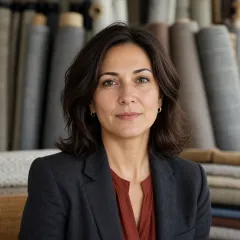
Lucia Bianchi is a woven apparel-fabric analyst covering cotton, linen, wool, rayon, denim, shirting, twill, satin, poplin, and blended garment fabrics. She applies the ISO 1833 series for fibre composition and ISO 105-C06 for laundering colourfastness while checking GSM, yarn count, usable width, shrinkage, skew, shade grade, drape, and surface defects. Her specification guides help designers, sourcing teams, and mills align fibre claims, lab dips, bulk tolerances, care conditions, and garment performance before production approval.